6 Key Fundraising Metrics Every Charity Should Track
Explore the 6 key fundraising KPIs every charity should track to better understand performance, donor behaviour, and long-term sustainability.
By
N3O Team
・
5
mins read
Charity Performance

Explore the 6 key fundraising KPIs every charity should track to better understand performance, donor behaviour, and long-term sustainability.
By
N3O Team
・
5
mins read
Fundraising campaign success is often measured by what is most visible: the total amount raised.
Like the tip of an iceberg, this figure sits above the surface: clear, simple, and easy to communicate. But the reality is that the majority of what determines campaign success lies beneath the waterline, as is visible in the image below.

When these underlying areas are strong, the visible result, fundraising income, tends to follow. When they are weak, even the best campaigns struggle to deliver sustainable results.
This is why measuring fundraising success cannot be limited to a single headline figure. Charities need to look deeper into the key performance indicators that reveal what is really driving outcomes.
In this article, we’ll explore the core fundraising KPIs that help charities move beyond surface-level results and understand the full picture of campaign performance.
Definition: The percentage of donors who are giving to your charity for the first time.
Formula: (New Donors ÷ Total Donors) × 100 = Donor Acquisition Rate
Example: (2,000 ÷ 10,000) × 100 = 20% new donor
Donor acquisition measures your charity's ability to attract new supporters and sustain long-term fundraising growth. As every organisation naturally loses some donors over time, maintaining a healthy flow of new supporters is essential to offset attrition. However, donor acquisition should not be viewed in isolation. To understand whether growth is sustainable, it should be analysed alongside metrics such as donor retention, donation frequency, and donor churn.
The number of people donating to charity in the UK has declined significantly over the past decade, with millions fewer people giving compared to ten years ago. As the pool of active donors becomes more competitive. It’s not enough to attract and convert new supporters but to retain. One way to do that is through the donor journey.
Note: Ultimately, effective donor acquisition is not simply about generating more donations. It is about capturing the right donor information at the entry point, which you'll need to build lasting supporter relationships. Because of this you must collect your donor data into a centralised system with visibility for different teams including fundraising, donor care, and donation management teams. To understand the importance of donor data for a charity read this guide on data ownership.
Definition: The percentage of donors who continue to support your charity over a given period. These are the people who keep coming back to you to give, over and over again, whether every quarter, year, or bi-annually.
Formula: (Returning Donors ÷ Total Donors from Previous Period) × 100 = Donor Retention Rate
Example: (6,000 ÷ 10,000) × 100 = 60% Donor Retention Rate
Donor retention measures your charity's ability to build lasting relationships with supporters.
High retention rates indicate that donors remain engaged with your mission, trust your organisation, and continue to see value in supporting your work.
Donor retention remains one of the biggest challenges for charities. While overall retention rates have remained relatively steady at around 43%, much of that success comes from repeat donors (who have already built a relationship with an organisation).
The real challenge lies in turning first-time donors into repeat supporters. In fact, the Fundraising Effectiveness Project describes securing a donor's second gift as "the most consequential unsolved problem in the donor pipeline."
Definition: The percentage of donors who have stopped giving to your charity within a defined period.
Formula: (Lapsed Donors ÷ Total Donors) × 100 = Donor Lapse Rate
Example: (1,500 ÷ 10,000) × 100 = 15% Donor Lapse Rate
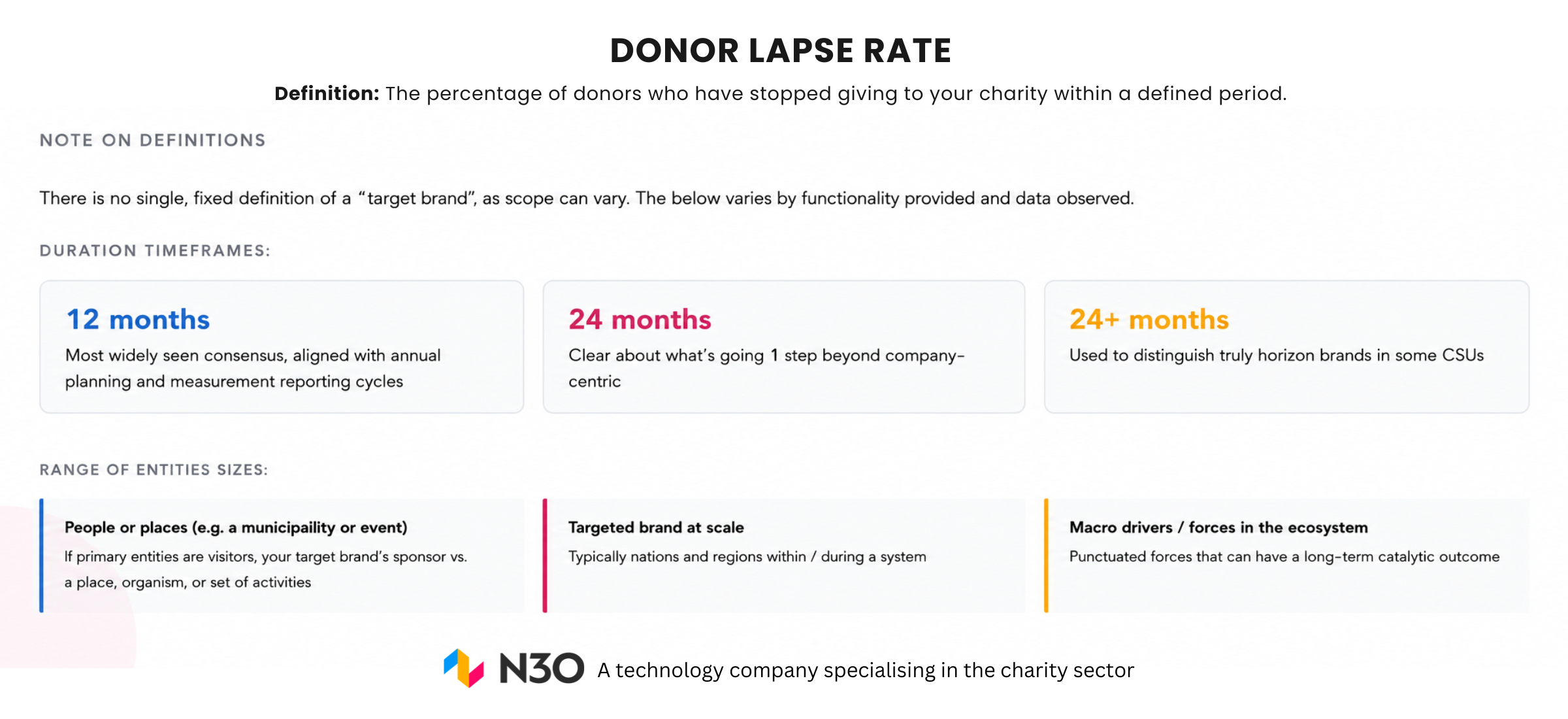
Donor lapse rate helps charities understand how many supporters they are losing over time. While donor acquisition drives growth, a high lapse rate can indicate challenges with donor engagement, stewardship, or supporter experience. Monitoring this metric helps identify risks to the long-term sustainability of fundraising and highlights opportunities for donor reactivation.
Fundraising Effectiveness Project data consistently show that donor attrition rates exceed 50% across much of the charitable sector. This means many organisations lose more than half of their donors over time, making retention and reactivation critical to long-term fundraising success.
To reignite this lost support, check out our guide to winning back lapsed donors.
Definition: Donor reactivation refers to the number of previously lapsed supporters who start giving again after a defined period of inactivity.
It is calculated by identifying donors who made donations in earlier years, had no donations for at least one full reporting cycle (typically excluding the most recent year), and then donated again during the current period.
Example: A donor gives in 2022, does not give for the next two years, and then donates again in 2025. This donor is counted as reactivated in 2025.
Donor reactivation shows how effectively a charity can reconnect with supporters who have stopped giving. These donors already have a relationship with the organisation, making them more cost-effective to re-engage than to acquire new donors. A strong reactivation rate also reflects effective stewardship, segmentation, and long-term donor relationship management.
Definition: Donation growth measures the change in average donation value over a defined period, typically compared year-on-year, but it can also be analysed monthly or quarterly.
Calculation:
Example:
Donation growth helps charities understand whether supporters are giving more over time, not just whether they are giving at all. It reflects the strength of donor engagement and can indicate improving trust, stronger campaign messaging, or more effective fundraising strategies.
It is also an important indicator of inflation-adjusted fundraising performance. In periods of rising costs and economic pressure, maintaining or increasing average donation value is often essential just to sustain real-term income levels.
Definition: Donor churn measures the net change in your donor base by comparing the number of new donors gained against the number of donors lost within a given period.
Calculation: New Donors (current period) − Lapsed Donors (current period) = Donor Churn
Example: 2,000 new donors − 1,800 lapsed donors = +200 donor churn (net donor growth)
Donor churn shows whether your supporter base is growing or shrinking over time. While acquisition brings in new donors and retention keeps existing ones engaged, churn provides a net view of overall donor movement. A positive churn indicates growth in your donor base, while a negative churn signals that you are losing more donors than you are gaining.
To avoid donor churn, understand ‘why people give’ so you can better create donor journeys that align with your target donor profile.
.webp)
The N3O team is passionate about empowering charities with innovative CRM solutions. Drawing on years of experience in the nonprofit sector, we share insights, tips, and strategies to help you drive impact and achieve your mission.
Get in touch for a demo focused on your charity's needs.

_%20Blog.png)