Income Leakage in Charities: 5 Hidden Causes of Lost Fundraising Income
Learn the five hidden causes of income leakage in charities, from abandoned donations and donor churn to platform fees, poor data ownership, and disconnected systems.
When charities review their fundraising performance, the focus usually falls on familiar metrics: total income, campaign results, and year-on-year growth.
But another metric rarely appears on dashboards: income leakage.
Income leakage refers to the potential donations charities never receive because of inefficiencies in technology, data management, or engagement strategies. It is not recorded as a loss in financial statements, but it represents support that donors were willing to give but never successfully delivered.
In the digital age, fundraising has become increasingly complex. Donors move across websites, social media platforms, and payment systems before completing a gift. At every step, small friction points can quietly reduce the amount of income reaching the charity.
When multiplied across thousands of supporters, these small drop-offs can translate into substantial unrealised income.
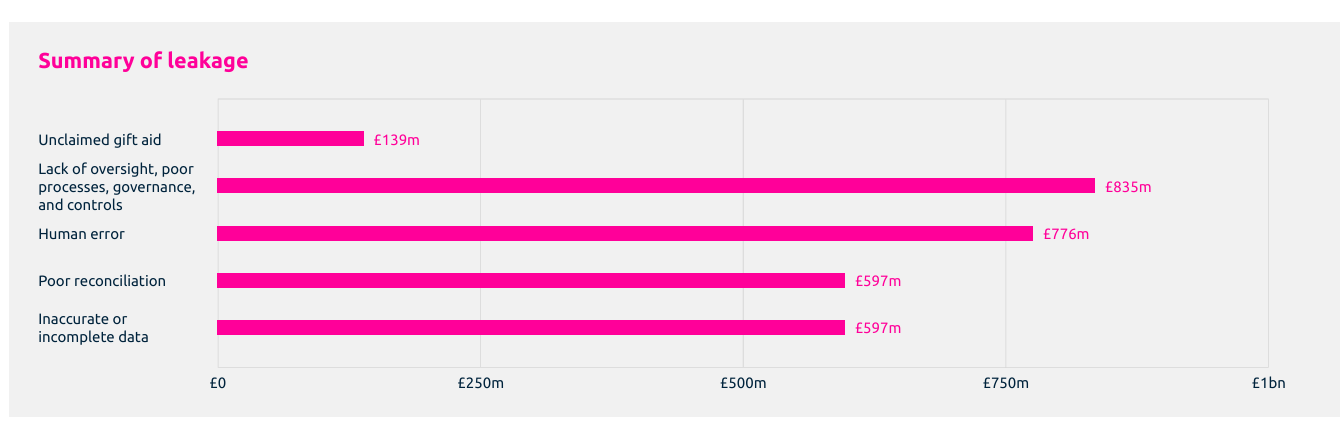
The same Missing Millions report says that around half of the revenue leakage is due to avoidable issues.
Poor reconciliation,
Poor processes, governance, and controls, lack of oversight,
Poor quality data,
Human errors are all rectifiable.
This highlights where the solution to charity income leakage lies.
Missing Million Report by Sagacity
To understand where these losses potentially occur, we need to examine the fundraising journey more closely. In most charities, five common “leaks” tend to appear.
Leakage #1 Abandoned Donations
When Donors Start Giving but Never Finish
Attracting someone to a donation page already represents a significant effort. It may have required advertising, storytelling, email campaigns, or social media engagement.
Yet for many charities, the donation process itself becomes the point where momentum disappears.
Security concerns: Online donors look for visible signs that their payment information is secure. Without clear trust indicators, donors may hesitate to proceed. (like, SSL certificate / HTTPS padlock icon, compliance logos)
Technical friction: Slow-loading pages, payment errors, or poor mobile optimisation can cause donors to abandon the process entirely.
Redirection to third-party platforms: Some donation journeys redirect donors to external payment pages. Even small transitions like this can break the giving experience and reduce completion rates.
In other words, the donation journey itself can inadvertently discourage the very people charities worked hard to engage.
For organisations running large digital campaigns, even modest improvements in conversion rates can recover significant revenue that would otherwise be lost.
Leakage #2 Lost First-Time Donors
The Supporters Who Never Return
A significant form of income leakage occurs after the first donation.
This creates a costly cycle for fundraising teams.
Acquiring new donors requires substantial effort, marketing campaigns, fundraising events, digital advertising, and staff time. But if most first-time donors never return, charities must continually spend resources replacing supporters who have quietly dropped away.
Without deliberate stewardship and structured donor journeys, the initial enthusiasm that motivated the first donation gradually fades, taking future fundraising potential with it.
Leakage #3 Third-Party Platform Fees
When Donations Shrink Before They Reach the Charity
Online fundraising platforms have helped charities reach wider audiences and run campaigns quickly. But they can also introduce another form of income leakage.
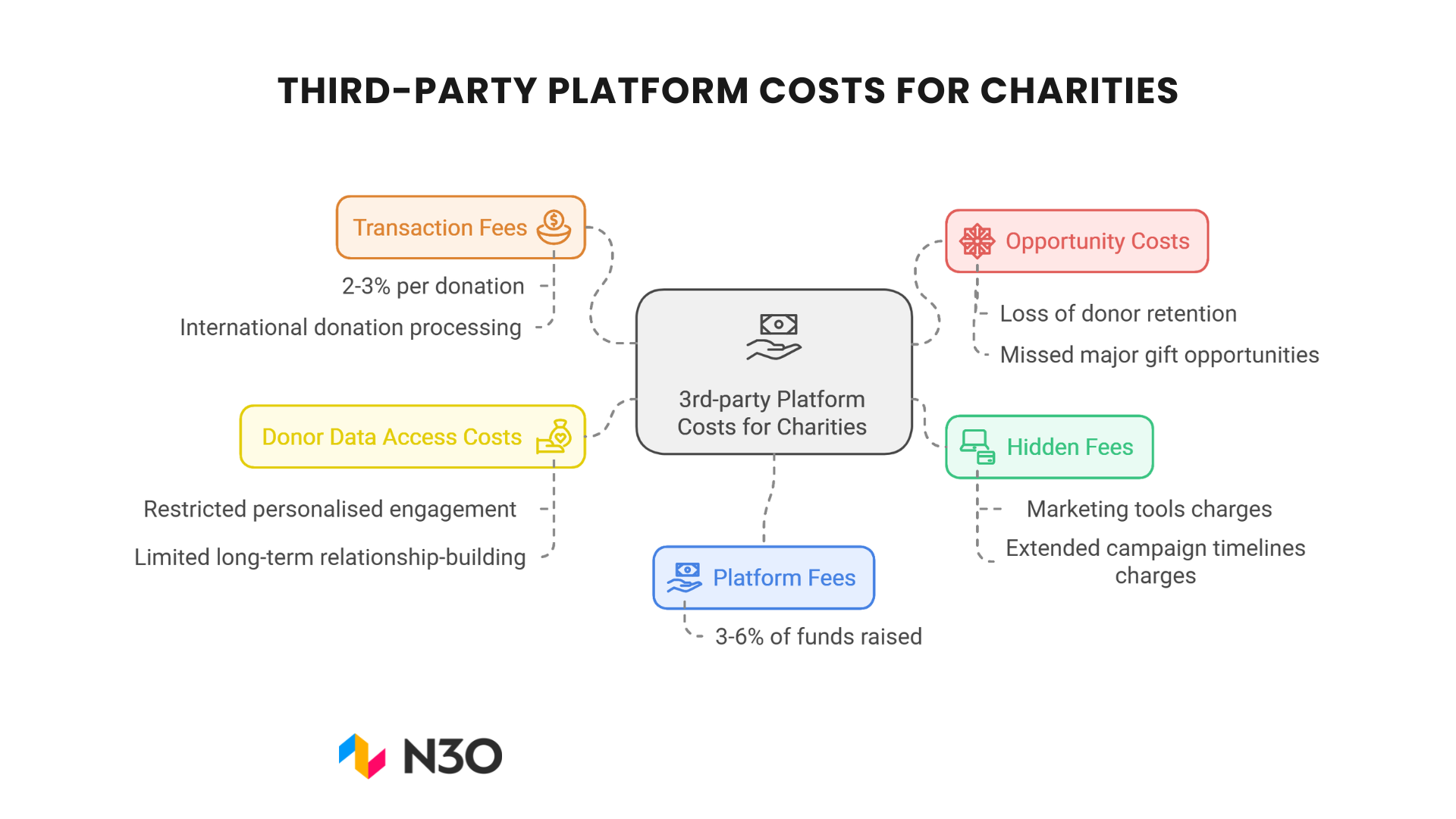
Many crowdfunding platforms charge a combination of platform fees and payment processing fees, meaning a portion of every donation never reaches the charity itself. In isolation, these fees may appear small. But over the course of large campaigns, they can accumulate into significant amounts of lost income.
Fee Type
Typical Range
Platform Fee
0% to 5%
Payment Processing Fee
1.5% to 3.0% + fixed fee (e.g. £0.20–£0.30 per donation)
Combined Effective Cost
Approximately 3% to 6% (sometimes higher for smaller donations)
Beyond the financial cost, there are also strategic considerations.
Some platforms limit access to full donor data or restrict how charities can engage with supporters after a campaign. This can weaken the charity’s ability to build long-term relationships with donors.
When Charities Don’t Fully Control Their Supporter Data
Fundraising success increasingly depends on understanding supporters: their interests, giving patterns, and engagement history.
But many charities struggle with fragmented or incomplete data.
Donor information may be spread across multiple tools, email platforms, fundraising sites, spreadsheets, and campaign systems. In some cases, key supporter insights may even be held by third-party platforms rather than the charity itself.
Without a clear, unified view of donors, charities face several challenges:
Incomplete supporter profiles: Without consolidated data, it becomes difficult to understand how donors interact across campaigns.
Limited personalisation: Personalised communication requires accurate donor insights.
Weak fundraising intelligence: Charities cannot easily identify which campaigns, channels, or messages drive donations.
In modern fundraising, data is not just an administrative asset; it is a strategic resource that shapes donor engagement and long-term fundraising growth.
Leakage #5 Disconnected Technology Systems
When Systems Don’t Talk to Each Other
The final and often overlooked source of income leakage is technology fragmentation.
Many charities operate with separate systems for:
fundraising platforms
donor databases
email communications
financial reporting
campaign tracking
When these systems do not integrate effectively, operational problems quickly emerge.
Staff may need to manually transfer data between platforms, increasing the risk of errors or duplication. Campaign insights may arrive too late to influence fundraising strategy. Donor records may become inconsistent across systems.
These inefficiencies can indirectly reduce fundraising performance by slowing down decision-making, weakening donor insight, and increasing operational workload.
By contrast, organisations with integrated fundraising infrastructure can track supporter engagement more effectively and respond quickly to donor behaviour. Here’s how.
Closing the Leaks in Charity Fundraising
Income leakage rarely happens because of a single major problem.
Instead, it usually emerges from small inefficiencies across the donor journey:
a donation form that takes too long to complete
a donor who never receives meaningful follow-up
a campaign running on platforms that take significant fees
data spread across disconnected systems
Individually, these issues may seem minor. But collectively, they can quietly reduce the amount of income charities generate.
The challenge for charities today is not only to attract new donors but to protect the value of the support they already inspire.
When charities optimise donor journeys, retain supporters more effectively, and build stronger digital infrastructure, they don’t just raise more money; they ensure that fewer opportunities are lost along the way.
About the author
Aqsa Deen
Content Marketer
Aqsa Deen is a skilled content marketer and writer at N3O, specialising in research-backed long-form content that helps charities amplify their impact through engaging narratives. When not crafting content, Aqsa indulges in the art of Islamic calligraphy and Illumination, blending creativity and tradition in every stroke.
Follow us
Continue your reading with these value-packed posts
.webp)
_%20Blog.png)