Beyond Tools: Why Charities Need an In-House IT Resource?
Many charities assume a CRM, website, and payment tools will run on their own. This article explains why internal IT ownership is essential to make technology deliver results.
“If we invest in a CRM like N3O or Salesforce, everything will just work.”
But technology (in charities) doesn’t work that way.
Buying a CRM, launching a new website, or integrating a payment gateway isn’t the finish line; it’s the starting point. Without internal ownership, even the best technology becomes underused, misconfigured, or disconnected from the organisation’s real workflows.
And that’s where many charities struggle.
The Myth of “Plug and Play” Technology
Modern charity systems are powerful. They can manage donor journeys, automate communications, process payments, and much more. But they don’t manage themselves.
Someone needs to:
Configure workflows
Manage user permissions
Maintain data quality
Understand how to use the system effectively
Build and refine donor journeys
Update templates
Test integrations
Troubleshoot gateway errors
In short, align the system with operational reality. Without an internal person responsible for these areas, systems slowly drift out of alignment with the organisation’s needs.
The result? Frustration, inefficiency, and missed fundraising opportunities.
The Sector Context: A Digital Skills Gap
Research across the third sector consistently highlights a digital skills gap. Many charities report a lack of internal technical leadership or confidence in their digital tools.
The issue isn’t access to software.
It’s ownership.
If charities invest in powerful systems without the internal capacity to support them, they struggle to unlock their full value.
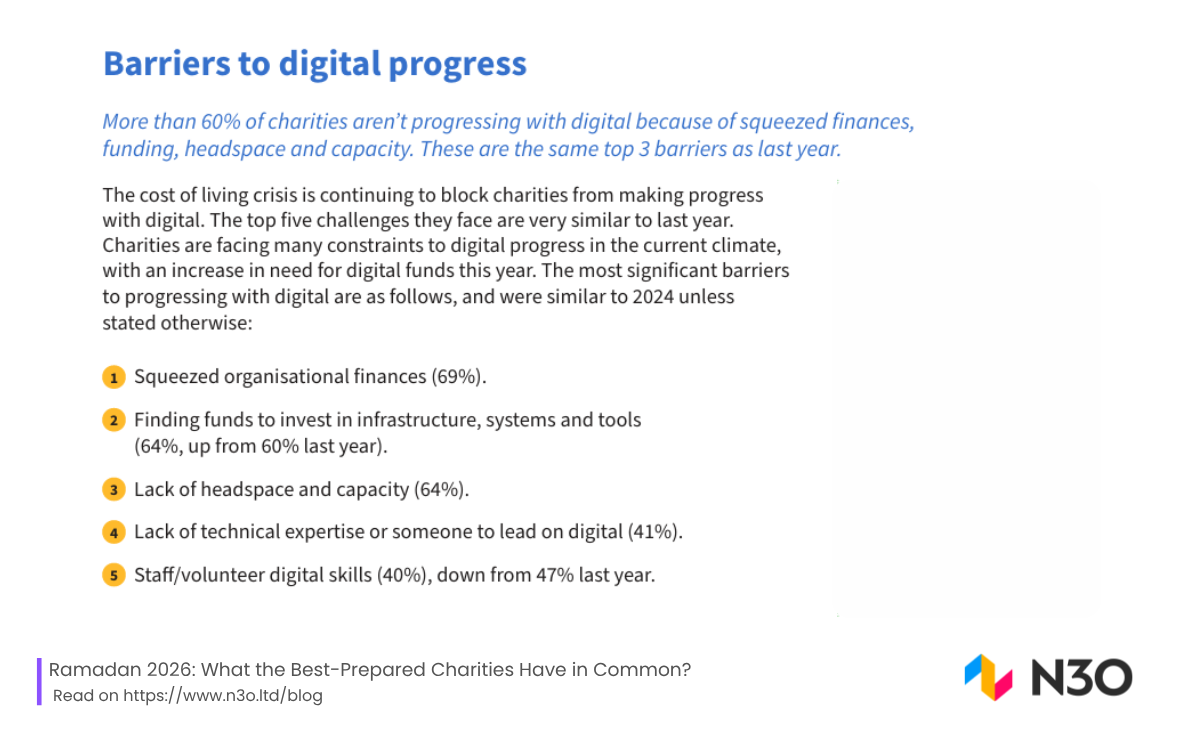
According to the Charity Digital Skills Report 2025, charities reported the following skills gaps among their top 5 barriers to progression:
Lack of technical expertise or someone to lead on digital (41%, vs 44% last year).
40% of charities see a lack of staff/ volunteer digital skills as a barrier to digital progress, down from 47% last year.
In addition, 43% of charities say that growing staff/ volunteer digital skills is a top priority.
The same survey respondents also reported cancelling services because either their charity or the people they support lacked the necessary skills or technology.
What an In-House IT Resource Actually Does?
When we talk about “in-house IT”, we don’t mean just fixing printers or resetting passwords.
When no one internally owns this, issues linger, and revenue can be affected.
4️. Website Management & Campaign Agility
Charity websites are no longer static brochures. They are fundraising engines.
An in-house digital resource enables:
Fast landing page creation (eg. on the back of emergency campaigns)
Content edits during campaigns
SEO adjustments
Mobile optimisation checks
Accessibility improvements
If every small website update requires external coordination, momentum is lost.
5️. Translating Organisational Workflow into Technology
Perhaps the most overlooked function of an internal IT resource is this: They understand how your organisation and the individual departments actually works. For example:
How the sponsorship teams want the sponsorship allocation workflow to work
How finance reconciles payments
How fundraising teams launch campaigns
How caseworkers input beneficiary data
How Programmes will want to view fund availability reports
External providers can configure tools, but they cannot intuit internal complexity. Only someone embedded in the organisation can continuously align systems with real operational processes.
The Cost of Not Having Internal IT Capacity
A lack of an internal tech resource often results in:
Campaign delays
Manual workarounds
Poor data quality
Duplicate donor records
Disconnected systems
Frustrated staff
Underutilised CRM features
Over time, this leads to a more serious outcome: Technology is seen as a burden rather than an enabler.
Why Outsourcing Alone Isn’t Enough?
Outsourced support plays an important role, providing implementation assistance and guidance when issues arise. However, it is inherently reactive, responding to tickets and resolving problems rather than shaping how technology is used day-to-day.
External partners cannot:
Drive internal adoption
Monitor day-to-day usage
Spot workflow inefficiencies early
Champion continuous improvement
For technology to deliver its full value, it needs a steward within the organisation, someone who understands internal processes and ensures systems continue to evolve alongside operational needs.
What Should an In-House IT Role Look Like?
The right structure depends on your size, complexity, and digital ambition, but every charity needs clear internal ownership of its technology. This doesn’t always mean a large team.
It could be:
A CRM administrator
A Systems & Data Lead
A Technology Operations Officer
A small internal digital team for larger charities
Core capabilities should include:
CRM administration
Website CMS management
Integration oversight
Data governance
Basic payment gateway understanding
Project and change management
Most importantly, they must have organisational awareness, not just technical skill.
Technology Is an Asset: But Only If Owned
Buying a CRM is not a digital strategy.
Launching a website is not a digital transformation.
Subscribing to a payment provider is not operational resilience.
Technology is a force multiplier, but only when someone internally owns it, maintains it, and evolves it. Charities that recognise this early unlock far more value from their systems. When they don’t, issues accumulate, and it can appear that the software isn’t working, when the real problem is the absence of internal stewardship.
About the author
Aqsa Deen
Content Marketer
Aqsa Deen is a skilled content marketer and writer at N3O, specialising in research-backed long-form content that helps charities amplify their impact through engaging narratives. When not crafting content, Aqsa indulges in the art of Islamic calligraphy and Illumination, blending creativity and tradition in every stroke.
Follow us
Continue your reading with these value-packed posts

.webp)