Charities continuously strive to fulfill their mission by collecting funds for running projects. However, advancing its impact by getting funds for investment projects is equally essential. While sustaining core mission projects already demands fundraising efforts, collecting funds from supporters for strategic projects offers yet another challenge for charities.
They must distribute funds carefully between ongoing and long-term projects like building a school, initiatives to support the environment, and more. This financial balancing act can hinder their capacity to grow or innovate, as most funding is designated for specific projects, leaving minimal resources for strategic initiatives and expansion projects.
Thus, in addition to raising project-specific funds, charities must focus on growing their unrestricted income. It will allow them not just to sustain but advance their mission. In this article, you’ll find key methods to increase your charity’s unrestricted funding.
What Is Unrestricted Income?
Unrestricted income for charities refers to funds received without specific conditions attached regarding their use. This means the charity can spend these funds however it sees fit to best achieve its objectives and mission.
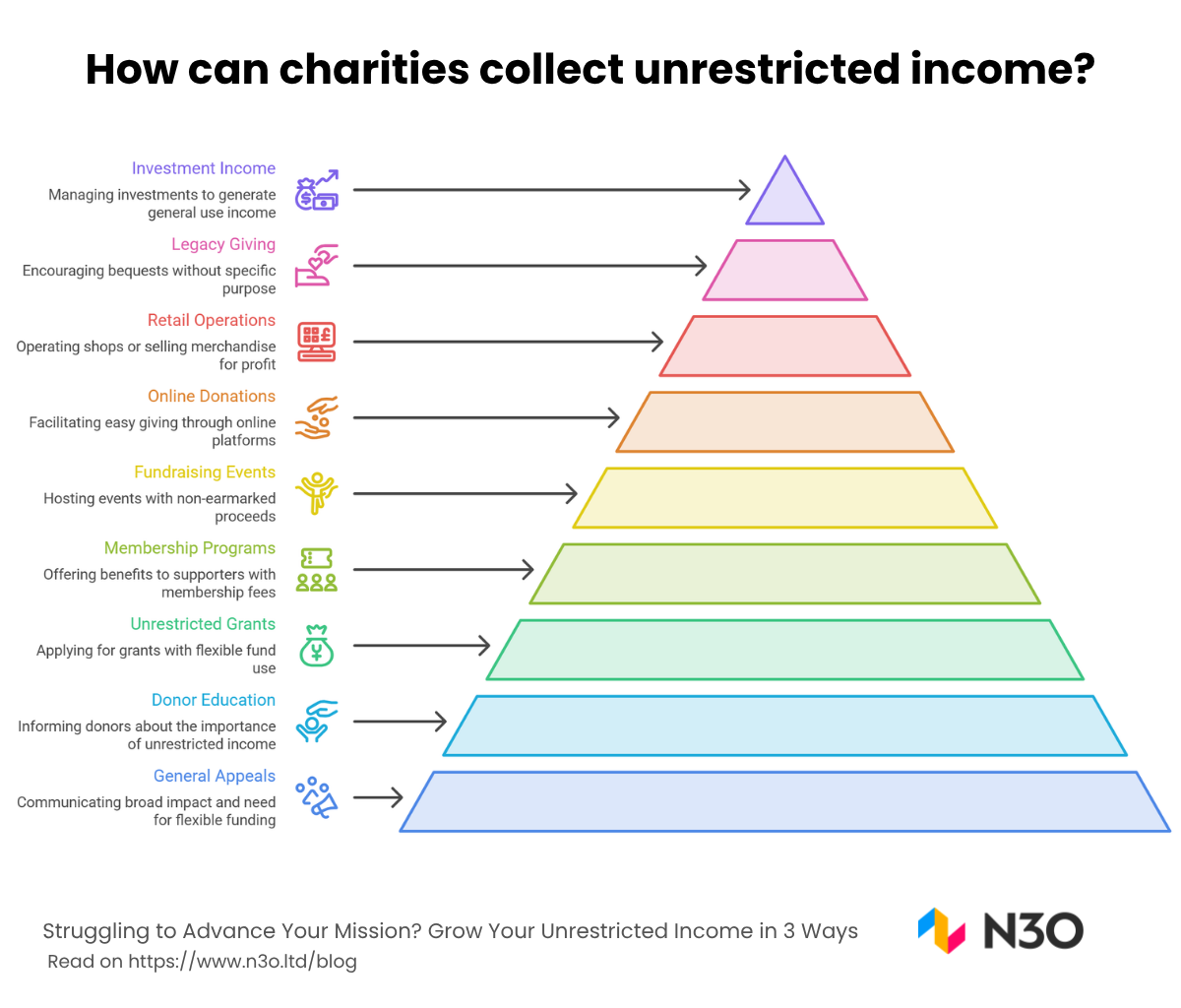
Unrestricted income is crucial for charities as it allows them to allocate resources where they are most needed, including unexpected costs or opportunities. It comes from various sources, including general donations, fundraising events, membership fees, unrestricted grants, etc.
These sources provide the financial flexibility needed for innovation and even responding to urgent or unforeseen circumstances.
Why Is Unrestricted Income Important for Charities?
Unrestricted income is valuable for the sustainability and growth of a charity, allowing for strategic planning and development beyond the scope of project-based funding. It can be used for the following purposes:
Strategic Planning: Unrestricted income enables long-term planning and investment in the charity's growth and development without donor-imposed restrictions, like investing in research initiatives that eventually support their cause or expanding into new geographic locations. These funds can also pilot new innovative projects (e.g. blockchain-based aid tracking) without specific project funding.
Emergency Preparedness: It provides a financial safety net that can be quickly accessed during a crisis or sudden need.
Leveraging More Funding: It serves as matching funds or proof of financial stability, attracting additional grants or donations.
Operational Stability: It can support core operating expenses, ensuring the charity's day-to-day functions and sustainability. Essential non-program expenses, such as staff salaries, rent, and utilities, often not funded by restricted income, can be covered with unrestricted income.
Organisational Autonomy: Empowers charities to use their expertise to allocate resources efficiently without being confined to donor-specific directives.
How Do Charities Benefit From Unrestricted Funding? - Case Study
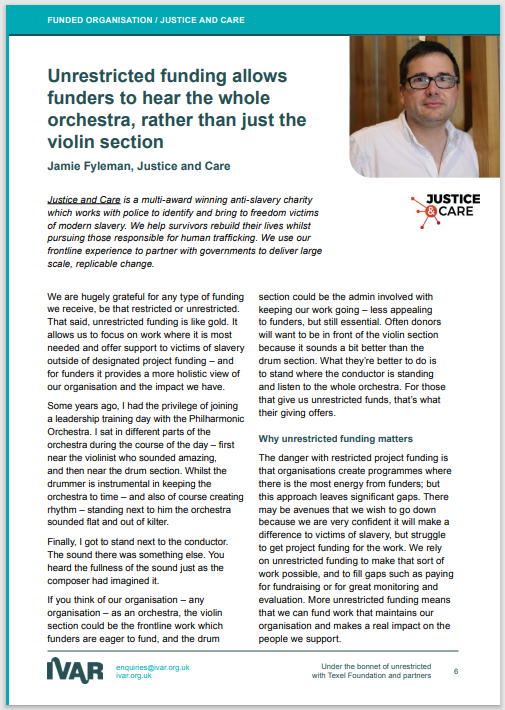
Unrestricted funding allows funders to hear the whole orchestra rather than just the violin section.
- Says Jamie Fyleman from Justice and Care Charity
Justice and Care is an acclaimed anti-slavery charity that collaborates with police to free and rehabilitate modern slavery victims while also working with governments. Having secured an unrestricted funding grant from the Texel Foundation, below is a summary of how it made a difference for them.
Unrestricted funding allowed the flexibility we needed to aid victims of slavery beyond the limits of specific projects.
It gave our funders a comprehensive understanding of our work and its wider impact, offering insights into our charity as a whole.
Unrestricted funds empowered us to pursue essential initiatives lacking direct funding that are critical to our mission.
This type of funding covered operational gaps, such as administrative costs and fundraising and evaluation efforts, often not addressed by project-specific grants.
It reflects the funder's confidence in the charity's vision and operational decisions, leading to simpler proposal processes and fostering stronger, trust-based relationships between funders and us.
You can read the complete case study here, along with others.
Refer to this resource to learn more about how unrestricted funding benefits a charity.
Ways Charities Can Improve Their Unrestricted Income
Below, we discuss five major strategies on how your charity can attract more unrestricted funding.
1. Build Your Foundation Through Regular Giving (Unrestricted by Design)
An immediately achievable route to sustainable unrestricted income is regular giving.
Regular donors are the backbone of a resilient charity. Small monthly gifts, £5, £10, £20, rarely come with restrictions attached. In a shrinking UK donor pool, converting occasional givers into committed monthly supporters is one of the few levers charities can pull themselves.
Yet retention is the real challenge: many charities are retaining as few as 18% of their donors. The charities countering this trend treat donor retention as a profit centre rather than an afterthought; investing in fast thank-yous, clear impact reporting, and consistent stewardship so that a donor giving £15 a month today becomes one giving £50 a month, and eventually a legacy donor, years down the line.
This is also where unrestricted income earns its keep operationally. Reserves, by definition, have to come from unrestricted funds, because reserves are built from unrestricted net assets, not funds tied to specific projects. A steady base of regular donors is often the most realistic way for a small or mid-sized charity to build that cushion, rather than waiting for a funder to relax its restrictions.
Rather than only chasing new donors, convert your existing one-off donors into monthly supporters; a faster, cheaper route to unrestricted income. N3O's One-off to Regular Conversion Calculator helps you model the impact and set a concrete target.
To make the case for unrestricted giving even clearer, consider:
Establishing a general fund: a named, transparent pool that regular gifts feed into, separate from restricted project funds.
Creating a dedicated page on your website explaining what the general fund is and why it matters: how it lets you respond to urgent needs, invest in staff and infrastructure, and act quickly rather than waiting on restricted approval cycles.
Highlighting innovation: use the general fund to show donors it powers the things restricted grants often won't: piloting new programmes, testing better ways of working, or investing in technology and training that make every other pound go further.
Framed this way, regular giving isn't just a fundraising channel, it's the flexible, dependable foundation that lets a charity plan ahead, take risks, and grow on its own terms.
2. Develop Strong Connections With Private Donors
Many funding bodies won't offer unrestricted support upfront, but private donors are often the most promising place to build it. Unlike institutional or bilateral donors, who typically require formal proposals, extensive due diligence, and multi-stage approval processes, private donors (high-net-worth individuals, business owners, and entrepreneurs) - usually come with far less red tape. They can decide to fund you quickly, flexibly, and repeatedly, once they trust you.
Reaching that stage requires dedication, time, and patience. It's often necessary to first secure a specific project gift from a donor, then invest in the relationship. The following can significantly help:
Thank them promptly and personally, not with a generic template.
Provide clear, honest reporting on the outcomes of what they funded.
Share successes candidly, and don't shy away from discussing challenges.
A practical way to structure this: set an internal target, such as building a base of 50 private donors giving £500-£1,000 a month (or an equivalent annual gift), specifically earmarked for administration, expansion, and innovation - the areas restricted grants rarely cover. Encourage these donors to renew their giving annually or move to a regular monthly commitment, rather than treating each gift as a one-off.
This relationship-first approach means your supporters won't hesitate to back campaigns with less specific, unrestricted purposes (whether on crowdfunding platforms or your own website) because they already trust that the funds go toward keeping the organisation running well.
The same principle applies to trust and foundation fundraising: one funder who is deeply engaged with your mission is worth far more than a long list of passive prospects. Many charities focus their energy in the wrong place, chasing new names instead of deepening existing relationships.
Treat your private donor base like membership in a club, not just a transaction list. Once a donor becomes genuinely familiar with your charity, consider offering:
Personal access: direct introductions or conversations with your CEO or leadership team.
Exclusive invitations: an annual networking dinner bringing together your business and philanthropic supporters.
Free invitations to events, launches, or milestone celebrations.
Introductions to other donors within your network.
Exclusive grant or funding opportunities reserved for your closest supporters.
Occasionally, unexpected additional funding support can arrive simply because a donor feels closely connected to your work. This outcome rarely happens by chance. It is the product of a deliberate, personal strategy to build genuine relationships with private donors, not a broad, impersonal fundraising net.
3. Generate Income Through Trading and Social Enterprise
Beyond grants and donations, charities can build unrestricted income through trading, running commercial activities where the profit is unrestricted, even if the goods or services themselves aren't tied to a specific charitable outcome.
The most common model is charity retail, and it remains a significant income source across the sector: the Charity Retail Association represents around 460 members operating almost 90% of the roughly 10,000 charity shops in the UK.
Organisations like Oxfam and the British Heart Foundation run networks of shops selling donated clothing, books, and household items, turning free-to-acquire stock into a steady income stream. Online resale is also a growing part of this picture: British Heart Foundation's online sales grew 15% to £17 million in 2025, while Oxfam's online sales rose 6.5% to £11.2 million, now making up 11% of its total retail income (source).
A charity doesn't need a nationwide shop network to apply this model, even a single shop, an online resale storefront, or a section of the charity's own website selling donated or branded goods can generate meaningful unrestricted income over time.
If your charity owns or leases a building, office space, a hall, meeting rooms, or a conference venue, venue hire is another underused option. Renting out unused space during evenings, weekends, or quieter periods creates income with minimal extra overhead, since the asset already exists.
Both approaches share the same appeal: once established, they generate income independent of donor sentiment or funding cycles, giving trustees more discretion over how it's used. That said, the retail sector isn't without pressure: rising costs and flat like-for-like income have squeezed profitability across the sector, so this route works best planned deliberately rather than treated as easy income.
4. Establish a Legacy Giving (Will) Service
Legacy giving (enabling supporters to leave a gift to your charity in their will) is one of the most powerful, although underused, routes to unrestricted income, and one of growing importance to the sector.
UK legacy income reached £4.4 billion in 2025. The long-term trajectory is strong too: the legacy market has grown at a long-term annual rate of 4.3% and is forecast to reach £5 billion by 2029..
Supporter appetite is also rising: A gap between willingness (40%) and action (26%) shows room to grow percentage-based legacy gifts, which already drive most legacy income. UK charitable legacies are exempt from Inheritance Tax, and estates that leave 10% or more to charity benefit from a reduced IHT rate, dropping from 40% to 36%.
"Charitable legacies are hugely valued across the sector, no matter the size of the gift or estate. But these insights into the high value legacy market reveal that legacy giving is even more prevalent in this space than many of us will have anticipated,"
- says Lucinda Frostick, Director of Remember A Charity.
To capture this, charities should create a dedicated legacy page on their website clearly explaining how a gift in a will supports the organisation, not just a single project. This is also an opportunity to make the case for giving to the organisation as a whole rather than earmarking a legacy for one specific cause: a gift restricted to a single project only helps that project, but an unrestricted legacy gift can have a compounding effect (sustaining staff roles, funding innovation, and strengthening the charity's ability to grow well beyond the donor's lifetime).
Because legacy income tends to be irregular and long-term by nature, it works best as a complement to the more immediate, predictable income regular giving provides. Together, they build both the day-to-day resilience and the long-term growth capacity a charity needs.
5. Adopt Integrated Funding Strategies: Core and Project Support Alignment
Target Funders Specialising in Core Support
Funders often gravitate towards financing specific, high-impact projects, which, while appealing, limit a charity’s ability to cover essential operational or administrative costs. In addition to project-specific funding, having access to core funding is equally crucial for a charity's sustainability.
In the UK, several funders provide core funding to support various charitable causes. While specific funders may change their funding priorities or available programs over time, the following are known to offer core funding:
The Esmée Fairbairn Foundation
The Garfield Weston Foundation
The Lloyds Bank Foundation for England and Wales
The Tudor Trust
The National Lottery Community Fund
Paul Hamlyn Foundation
And more
Use the following funding directories to find more core funders:
Charities interested in applying for core funding should thoroughly research each funder's priorities, eligibility, application processes, and deadlines to ensure the best fit for their needs. Focus on the following points to develop a compelling case, detailing:
Your lack of unrestricted funding.
How would core funding benefit your charity (e.g., hiring staff, seizing opportunities, restructuring)?
Your charity's expertise and strength as a core funding candidate.
Add Operating Support to Project Support
One transformative idea to enhance your unrestricted income is integrating a general operating support component into each project appeal. It means that in addition to securing funds for specific projects, you receive an unrestricted general donation, potentially starting with 10% of the project’s total value.
This method can not only pay for your basic costs completely but also gives essential flexible money.
For instance, if your annual income is about £300k a year, 75% of which comes from restricted appeals, a 10% increase in unrestricted funds could significantly bolster your capacity. An additional £30k annually could help start new initiatives, improve your technology, or build up your savings and expansion.
Unrestricted Income - A Must-Have for the Future
The pandemic highlighted the critical role of charity reserves, revealing both a shortage of reserves across the sector and a hesitance to utilise them.
To foster a third sector that is agile, creative, and resilient, charities must rethink their approach to funding. Securing funds for helping communities thrive with support beyond specific projects should be viewed as integral to your charity mission, much like the private sector's reliance on profit margins for reinvestment and growth.
By adopting these strategies, you can break free from the 'starvation cycle' of funding, ensuring continued innovation and community service.
About the author
Aqsa Deen
Content Marketer
Aqsa Deen is a skilled content marketer and writer at N3O, specialising in research-backed long-form content that helps charities amplify their impact through engaging narratives. When not crafting content, Aqsa indulges in the art of Islamic calligraphy and Illumination, blending creativity and tradition in every stroke.
Follow us
Continue your reading with these value-packed posts
.webp)
_%20Blog.png)