Ramadan 2026: What the Best-Prepared Charities Have in Common?
The charities that run smooth, high-impact Ramadan campaigns share one quiet advantage: clean, unified donor data. Discover how?
By
Aqsa Deen
・
4
mins read
Charity Performance

The charities that run smooth, high-impact Ramadan campaigns share one quiet advantage: clean, unified donor data. Discover how?
By
Aqsa Deen
・
4
mins read
Ramadan is a season of immense generosity, with donors actively seeking ways to give. Did you know that 62% of Muslims in the UK who pay Zakat do so during Ramadan, with a significant number contributing in the last 10 days? This highlights an incredible opportunity for charities to engage donors meaningfully and achieve their fundraising goals.
While tradition and goodwill shape Ramadan giving, the best-prepared charities are not simply those with the most campaigns or the largest budgets. They win because they have data hygiene: clean, organised, and unified donor data: a single source of truth that drives smarter fundraising, better supporter experiences, and long-term growth.
In this article, we explore how clean data is enabling charities to better prepare for Ramadan success (and beyond).
Data hygiene for charities is the practice of keeping supporter information accurate, complete, and up to date across all systems where it is stored.
In simple terms, it means:
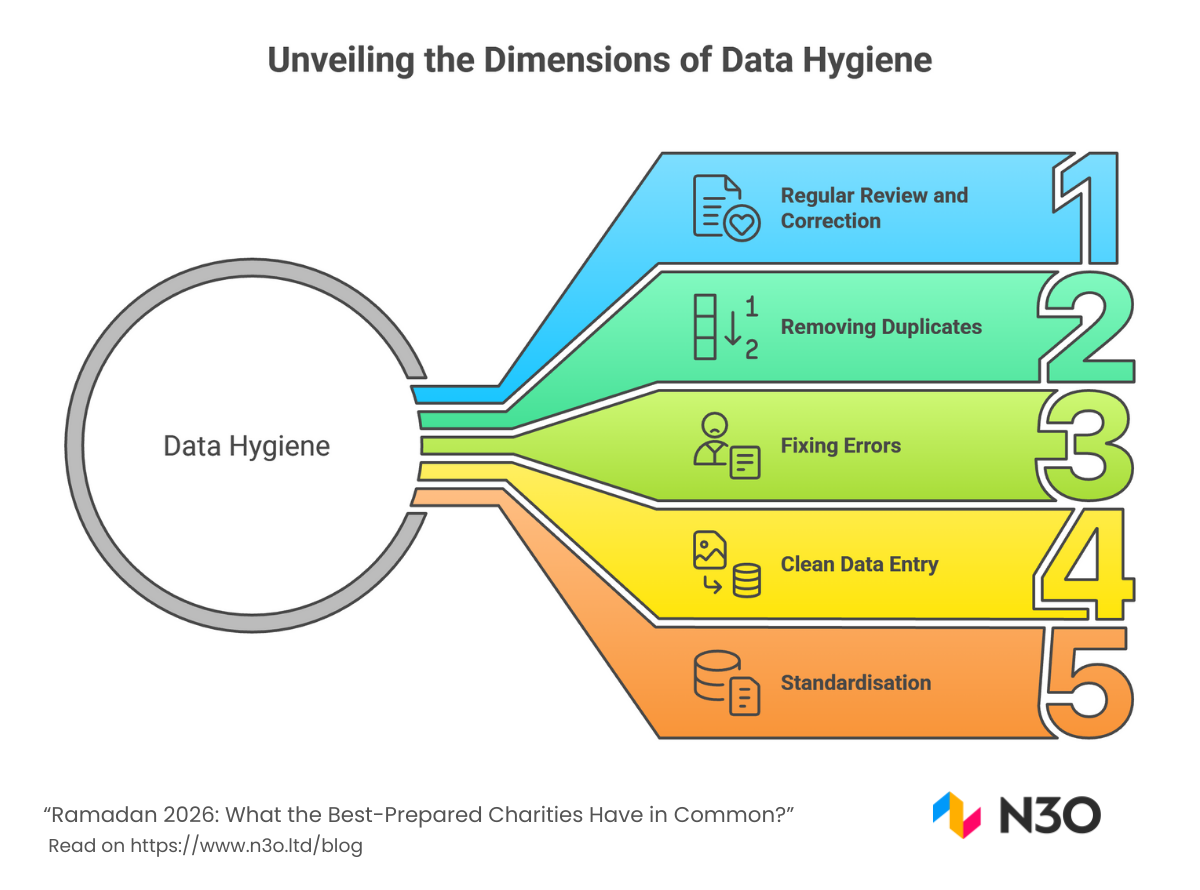
For charities, clean data isn’t just tidy record-keeping: it enables reliable reporting, effective segmentation, stronger donor stewardship, and better fundraising outcomes.
When supporter information is trusted and structured properly, teams can communicate confidently, personalise engagement, and build long-term donor relationships, especially during critical giving periods such as Ramadan and year-round.
Beyond being an administrative hassle, messy data means lost fundraising revenue. Here’s how:
All of the above forces guesswork rather than smart segmentation. For example, throughout the year, charities receive an influx of new donor records that they can utilise later for campaigns, such as during peak giving seasons (Ramadan or Christmas). If many of those entries contain spelling mistakes, missing phone numbers, or invalid emails, staff can’t actually contact supporters when the next appeal launches.
A simple data cleanse, validating contact fields or filling gaps using inbound forms, better positions a nonprofit to segment and personalise communication, improving both engagement and stewardship.
Takeaway: Every messy record is a potential missed donation, especially during Ramadan, when donors expect relevant, timely communications.
When fundraising, marketing, finance, and donor care teams each work with different spreadsheets or partial views of data, misalignment and friction are inevitable. Unified data changes that.
Here’s how: imagine a scenario where:
The fundraising team is tracking donors in a spreadsheet, Marketing is working from Mailchimp lists, and Finance is reconciling Gift Aid forms independently.
It becomes impossible to answer basic questions such as “How many donors supported us last Ramadan?” or “Who already gave this week?” Switching to a unified database provides a point of convergence for different teams to access relevant information.
With one source of truth:
Takeaway: Unified, clean data accelerates collaboration. It eliminates conflicting answers, prevents duplicate work, and ensures every team sees the same history, which is essential when campaigns move quickly during Ramadan nights.
Ramadan appeals are inherently emotional, tied to religious duty, community, and compassion. To tap into that meaning, personalisation is a must.
Accurate donor profiles let charities:
When donor preferences are recorded clearly, for example, Zakat, Sadaqah, Sadaqah Jariyah, first-time donor, monthly donor, charities can shape messaging to match motivation rather than sending a single blanket appeal to everyone.
Clean data enables:
This kind of differentiation is only possible when supporter records are complete and consistently tagged.
Takeaway: Clean data enables meaningful automation that speaks to the person, not at a list.
Fundraising is more than a one-off exchange; it’s a journey. At scale, that journey looks like:
Tag → Segment → Target → Engage → Thank → Retain

Every step depends on reliable data:
When data is patchy, journeys break midstream, and overworked charity teams burn out trying to fix them manually. But when data is clean and systems are connected, automated donor journeys scale effortlessly, freeing staff to focus on strategy and stewardship.
Automated journeys depend entirely on reliable information. For example, a charity using automation may set conditions such as:
If donor records contain duplicates or incorrect activity logs, the system may:
Moreover, clean data plays a quiet but essential role in building that trust:
Something as small as addressing a supporter by their correct name and recognising their previous gift goes a long way. If donor names are misspelled, merged incorrectly, or attached to the wrong donation history, communications come across as careless or generic, undermining trust.
Takeaway: Clean, tagged, and centralised records ensure journeys run smoothly, even when donation surges at midnight. And donors are more likely to give again, and again, when they feel recognised and valued.
Nowhere is data hygiene more cost-effective than in digital fundraising. Why? Because:
Reports on data quality highlight that clean data isn’t just operationally efficient, it’s financially smart. (Nonprofit Learning Lab)
Poor-quality data drains resources quietly. If one out of every ten email addresses is invalid, that means:
Clean data reduces lists to real, reachable supporters, so every pound spent on SMS, email, and postage is more likely to convert.
Takeaway: Data hygiene is one of the cheapest upgrades with the biggest fundraising (Ramadan) payoff.
Ramadan fundraising success is built on clean data. But capturing clean data during Ramadan appeals results in a rather enriched donor dataset. Post-Ramadan, charities can analyse patterns, retarget to seasonal supporters, and build tailored stewardship plans (for Qurbani, Winter Emergency Appeals, or year-end giving).
In short, capturing clean data and maintaining data hygiene helps convert the giving moment into meaningful year-round engagement.
Start now:
.webp)
Aqsa Deen is a skilled content marketer and writer at N3O, specialising in research-backed long-form content that helps charities amplify their impact through engaging narratives. When not crafting content, Aqsa indulges in the art of Islamic calligraphy and Illumination, blending creativity and tradition in every stroke.
Get in touch for a demo focused on your charity's needs.
_%20Blog.png)